UIKit15 min readMay 30, 2026

Mastering the UIKit App Lifecycle: A Comprehensive Developer Guide

Understanding the UIKit app lifecycle is fundamental for every iOS developer. This guide explores the various states your app can enter, the crucial methods UIKit calls during transitions, and how to effectively manage resources, background tasks, and user interactions to build resilient and responsive applications.

Mastering the UIKit App Lifecycle: A Comprehensive Developer Guide

Introduction to the UIKit App Lifecycle

Every iOS application, whether it's a simple utility or a complex game, follows a predictable lifecycle managed by UIKit and the operating system. This lifecycle dictates how your app starts, runs, pauses, resumes, and terminates. A deep understanding of these states and the methods associated with them is crucial for building stable, efficient, and user-friendly applications. Without this knowledge, you might encounter issues like data loss, performance degradation, or even app crashes.

Historically, AppDelegate was the central hub for managing the entire app's lifecycle. With the introduction of iOS 13 and SceneDelegate, Apple modularized this responsibility, especially for apps supporting multiple windows or scenes. This separation of concerns allows for more flexible and scalable application architectures, particularly on devices like the iPad where users can run multiple instances of the same app or different parts of an app concurrently. For apps targeting iOS 13 and later, you'll primarily interact with both AppDelegate for process-level events and SceneDelegate for UI-related lifecycle events.

This article will guide you through the various app states, explain the roles of AppDelegate and SceneDelegate, and provide practical examples of how to implement lifecycle methods to handle common scenarios like saving user data, responding to memory warnings, and managing background tasks.

Key App States and Their Meanings

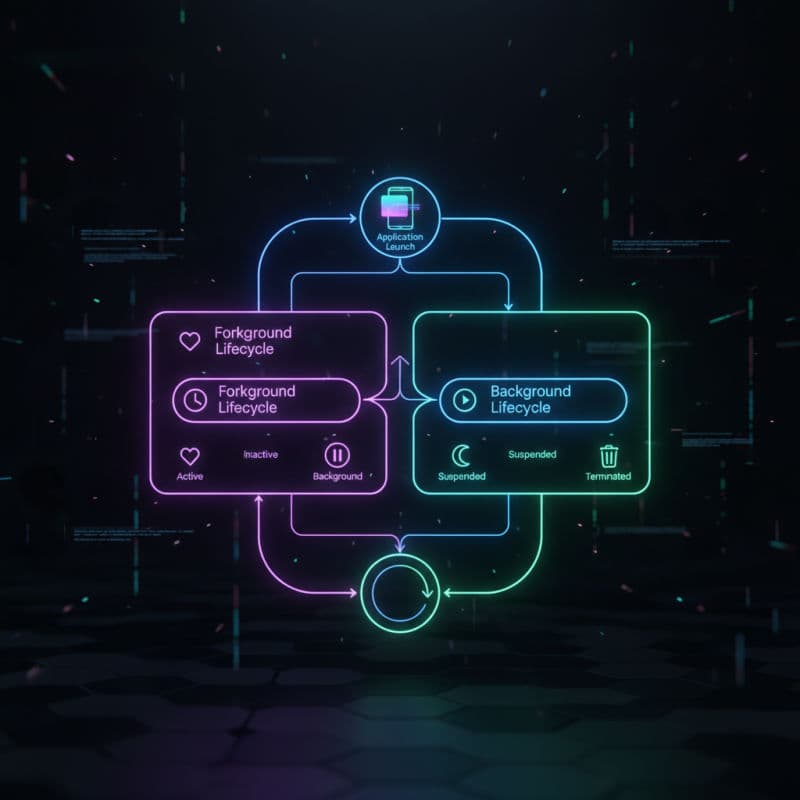
Your application can exist in several distinct states, each triggering specific behaviors and API calls. Understanding these states is paramount to managing your app's resources and user experience effectively.

  1. Not Running: The app has not been launched or was terminated by the system.

  2. Inactive: The app is running in the foreground but is not receiving events. This often happens momentarily when a phone call or SMS message is received, or when the user pulls down the Notification Center while your app is active. The UI is visible but user interaction is paused.

  3. Active: The app is running in the foreground and is receiving events. This is the normal operating mode for an app.

  4. Background: The app is in the background and executing code. Most apps briefly enter this state on their way to being suspended, but some apps can request extra execution time or support specific background execution modes (like playing audio, tracking location, or performing background fetches). When your app enters the background, its UI is no longer visible.

  5. Suspended: The app is in the background and has been explicitly suspended by the system, or implicitly suspended because it finished executing background tasks. A suspended app remains in memory but executes no code. The system may purge suspended apps from memory without warning at any time to free up resources.

Transitions between these states are managed by the operating system, which notifies your app through delegate methods. You, as the developer, implement these methods to react appropriately.

The Role of AppDelegate: Process-Level Events

The AppDelegate class is the entry point for your application and acts as the heart of your app's interaction with the operating system at a process level. It conforms to the UIApplicationDelegate protocol and is responsible for critical events that affect the entire application instance, regardless of how many scenes (windows) it has. For apps supporting iOS 13 and later, AppDelegate primarily handles system-level events such as app launch, termination, memory warnings, push notification registration, and configuration of new UISceneSession instances.

Here's a breakdown of the most critical AppDelegate methods:

  • application(_:didFinishLaunchingWithOptions:): This is the first method called when your app launches. It's your primary opportunity to perform essential setup, such as configuring third-party SDKs, setting up your initial UI (for pre-iOS 13 apps or UIScene setup for later versions), and preparing your data model. It returns a Bool indicating whether the app successfully finished launching. For apps with SceneDelegate, this method is where you'd set up default UISceneConfigurations.

  • application(_:configurationForConnecting:options:): (iOS 13+) This method is called to request a configuration object for a new scene. You use it to specify the SceneDelegate class to be used for this new scene.

  • application(_:didDiscardSceneSessions:): (iOS 13+) This method is called when the user discards one or more scenes. You can use it to clean up any resources associated with those discarded scenes that might not be automatically released.

  • applicationWillResignActive(_:): Called when the app is about to move from active to inactive. Use this to pause ongoing tasks, disable timers, and generally prepare for a temporary interruption. This method is called before sceneWillResignActive for all scenes.

  • applicationDidEnterBackground(_:): Called when the app transitions from inactive to the background. You should save user data, release shared resources, and prepare for potentially being suspended. Requesting extra background task execution time can be done here.

  • applicationWillEnterForeground(_:): Called as the app transitions from the background to inactive. Used to undo changes made when entering the background and prepare to become active again.

  • applicationDidBecomeActive(_:): Called when the app transitions from inactive to active. Restart any tasks that were paused when the app resigned active. This method is called after sceneDidBecomeActive for all scenes.

  • applicationWillTerminate(_:): Called when the app is about to be terminated. This method gives you one last chance to save critical user data. However, relying solely on this method for data persistence is risky, as the system might terminate your app without calling it (e.g., due to memory pressure).

Let's look at an example implementation for saving user defaults upon entering the background:

swift
import UIKit

@main
class AppDelegate: UIResponder, UIApplicationDelegate {

    func application(_ application: UIApplication, didFinishLaunchingWithOptions launchOptions: [UIApplication.LaunchOptionsKey: Any]?) -> Bool {
        // Override point for customization after application launch.
        print("App finished launching.")
        // Example: Configure a global analytics SDK
        // AnalyticsManager.shared.configure()
        return true
    }

    // MARK: UISceneSession Lifecycle (iOS 13+)

    func application(_ application: UIApplication, configurationForConnecting connectingSceneSession: UISceneSession, options: UIScene.ConnectionOptions) -> UISceneConfiguration {
        // Called when a new scene session is being created.
        // Use this method to select a configuration to create the new scene with.
        print("Configuring new scene session.")
        return UISceneConfiguration(name: "Default Configuration", sessionRole: connectingSceneSession.role)
    }

    func application(_ application: UIApplication, didDiscardSceneSessions sceneSessions: Set<UISceneSession>) {
        // Called when the user discards a scene session.
        // If any sessions were discarded while the application was not running, this will be called shortly after application:didFinishLaunchingWithOptions.
        // Use this method to release any resources that were specific to the discarded scenes, as they will not return.
        print("Discarded scene sessions: \(sceneSessions.count)")
    }

    // MARK: Process-level App Lifecycle Events

    func applicationWillResignActive(_ application: UIApplication) {
        // Sent when the application is about to move from active to inactive state. This can occur for certain types of temporary interruptions (suchs as an incoming phone call or SMS message) or when the user quits the application and it begins the transition to the background state.
        // Use this method to pause ongoing tasks, disable timers, and invalidate graphics rendering callbacks. Games should use this method to pause the game.
        print("App will resign active.")
    }

    func applicationDidEnterBackground(_ application: UIApplication) {
        // Use this method to release shared resources, save user data, invalidate timers, and store enough application state information to restore your application to its current state in case it is terminated later.
        // If your application supports background execution, this method is called instead of applicationWillTerminate: when the user quits.
        print("App entered background. Saving user preferences...")
        UserDefaults.standard.set(Date(), forKey: "lastBackgroundTime")
        UserDefaults.standard.synchronize() // Ensures immediate write, though often not strictly necessary.

        // Requesting a short amount of extra execution time for cleanup.
        var backgroundTask: UIBackgroundTaskIdentifier = .invalid
        backgroundTask = application.beginBackgroundTask(withName: "MyCleanupTask") { [weak self] in
            // End the task if time expires
            application.endBackgroundTask(backgroundTask)
            backgroundTask = .invalid
            print("Background task for cleanup expired.")
        }

        DispatchQueue.global().async { [weak self] in
            // Perform some non-UI related cleanup or data saving here
            Thread.sleep(forTimeInterval: 2) // Simulate work
            print("Finished background cleanup task.")
            application.endBackgroundTask(backgroundTask)
            backgroundTask = .invalid
        }
    }

    func applicationWillEnterForeground(_ application: UIApplication) {
        // Called as part of the transition from the background to the active state; here you can undo many of the changes made on entering the background.
        print("App will enter foreground.")
        if let lastTime = UserDefaults.standard.object(forKey: "lastBackgroundTime") as? Date {
            print("App was last in background at: \(lastTime)")
        }
    }

    func applicationDidBecomeActive(_ application: UIApplication) {
        // Restart any tasks that were paused (or not yet started) while the application was inactive. If the application was previously in the background, optionally refresh the user interface.
        print("App did become active.")
    }

    func applicationWillTerminate(_ application: UIApplication) {
        // Called when the application is about to terminate.
        // Save data if needed, but rely on background save for robustness.
        print("App will terminate. Performing final save...")
        // Example: Core Data save context
        // (self as? CoreDataStack)?.saveContext()
    }

    // MARK: Memory Warnings

    func applicationDidReceiveMemoryWarning(_ application: UIApplication) {
        // Called when the application receives a memory warning from the system.
        // Release shared resources, caches, or image data that can be reloaded later.
        print("\u{26A0}️ Application received memory warning!\u{26A0}️")
        // Example: Clear image caches
        // ImageCache.shared.clearCache()
    }
}

The Rise of SceneDelegate: UI-Specific Lifecycle (iOS 13+)

Starting with iOS 13, Apple introduced SceneDelegate to manage the lifecycle of a UIScene (window), which represents an instance of your app's UI. This is particularly important for iPad apps, which can support multiple windows, and for features like Split View and Multitasking on iPhone. Each UISceneSession (often corresponding to a single window) has its own SceneDelegate instance, allowing for independent UI state management.

Key SceneDelegate methods include:

  • scene(_:willConnectTo:options:): This is the first method called when a new scene is created and connected. It's where you configure the scene's window property, set its rootViewController, and establish the initial UI.

  • sceneDidDisconnect(_:): Called when a scene is disconnected. This happens when the user closes a window or the system terminates a scene that was running in the background. You should release resources specific to this scene here, as it might not reconnect.

  • sceneWillResignActive(_:): Called when the scene is about to move from an active to an inactive state. Similar to applicationWillResignActive, but specific to a single scene.

  • sceneDidEnterBackground(_:): Called when the scene transitions to the background. Save scene-specific state and release resources here.

  • sceneWillEnterForeground(_:): Called when the scene transitions from the background to the foreground. Restore scene-specific state.

  • sceneDidBecomeActive(_:): Called when the scene becomes active. This is where you would restart UI-related tasks or animations specific to this scene. This is often the best place to refresh the visual state of your UI.

For apps supporting iOS 13 and later, the typical flow for launching a scene is: AppDelegate.application(_:didFinishLaunchingWithOptions:) -> AppDelegate.application(_:configurationForConnecting:options:) -> SceneDelegate.scene(_:willConnectTo:options:).

Here's an example of a SceneDelegate handling window setup and state management:

swift
import UIKit

class SceneDelegate: UIResponder, UIWindowSceneDelegate {

    var window: UIWindow?


    func scene(_ scene: UIScene, willConnectTo session: UISceneSession, options connectionOptions: UIScene.ConnectionOptions) {
        // Use this method to optionally configure and attach the UIWindow `window` to the provided UIWindowScene `scene`.
        // If using a storyboard, the `window` property will automatically be initialized and attached to the scene.
        // This delegate does not imply that the connecting scene is an active scene.
        // Use this method to select a configuration to create the new scene with.
        print("Scene will connect.")

        guard let windowScene = (scene as? UIWindowScene) else { return }
        window = UIWindow(windowScene: windowScene)
        let viewController = UIViewController() // Replace with your initial view controller
        viewController.view.backgroundColor = .systemBackground
        viewController.title = "My App Scene"
        window?.rootViewController = UINavigationController(rootViewController: viewController)
        window?.makeKeyAndVisible()
    }

    func sceneDidDisconnect(_ scene: UIScene) {
        // Called as the scene is being released by the system.
        // This occurs shortly after the scene enters the background, or when its session is discarded.
        // Release all resources associated with this scene that can be re-created the next time the scene connects.
        // The scene may re-connect later, as its session was not necessarily discarded.
        print("Scene disconnected.")
    }

    func sceneWillResignActive(_ scene: UIScene) {
        // Called when the scene will move from an active state to an inactive state.
        // This may occur due to temporary interruptions (ex. an incoming phone call).
        print("Scene will resign active.")
    }

    func sceneDidEnterBackground(_ scene: UIScene) {
        // Called as the scene transitions from the foreground to the background. Informs the scene that it is no longer visible and may be suspended at any time.
        // Use this method to save data, release shared resources, and store enough scene-specific state information to restore the scene back to its current state in case it is terminated later.
        // If your scene supports background execution, this method is called instead of sceneWillResignActive: when the user quits.
        print("Scene entered background. Saving scene-specific data...")
        if let viewController = (window?.rootViewController as? UINavigationController)?.topViewController {
            // Example: save state of the currently visible view controller specific to this scene
            UserDefaults.standard.set("Scene backgrounded at \(Date())", forKey: "sceneBackgroundState")
        }
    }

    func sceneWillEnterForeground(_ scene: UIScene) {
        // Called as the scene transitions from the background to the foreground.
        // Use this method to undo the changes made when the scene entered the background.
        print("Scene will enter foreground.")
        if let savedState = UserDefaults.standard.string(forKey: "sceneBackgroundState") {
            print("Restoring scene state: \(savedState)")
        }
    }

    func sceneDidBecomeActive(_ scene: UIScene) {
        // Called when the scene has moved from an inactive state to an active state.
        // Use this method to restart any tasks that were paused (or not yet started) when the scene was inactive.
        print("Scene did become active. Refreshing UI elements...")
        // Example: Refresh content, restart animations
    }
}

Handling Background Execution and Resource Management

Efficiently managing your app's resources, especially when it moves into the background, is critical for a good user experience and system stability. iOS strictly regulates background execution to conserve battery life and memory.

Background Tasks: If your app needs a short amount of extra time to finish a task (e.g., uploading a file, saving data) after moving to the background, you can request a limited extension using UIApplication.beginBackgroundTask(withName:expirationHandler:). This grants your app a few extra seconds (typically around 30 seconds) to complete its work. It's crucial to call endBackgroundTask(_:) once your task is complete or if it expires, to avoid your app being terminated by the system.

Long-Running Background Modes: For tasks that require prolonged background execution (e.g., playing audio, tracking location, VoIP, rich push notifications, background fetch, background processing), you must explicitly declare these capabilities in your app's Info.plist file (under 'UIBackgroundModes'). Misusing these modes can lead to app rejection or excessive battery drain.

Memory Management: When your app receives a applicationDidReceiveMemoryWarning(_:) call (via AppDelegate), it's a strong signal from the operating system that memory is scarce. You should respond by releasing any non-critical resources, such as cached images, large data structures, or off-screen view controller views, that can be easily recreated. Failure to do so can lead to your app being terminated by the system without warning, especially if it's in the background.

Let's expand on the UISceneDelegate example to show how a scene might manage resources when actively becoming inactive, and how to use NotificationCenter to observe memory warnings globally that might affect specific scenes or view controllers.

swift
import UIKit

class MyViewController: UIViewController {

    var largeImageDataCache: [UIImage] = []

    override func viewDidLoad() {
        super.viewDidLoad()
        view.backgroundColor = .white
        title = "Resourceful View Controller"
        setupUI()

        // Observe memory warnings to release scene-specific resources
        NotificationCenter.default.addObserver(self,
                                               selector: #selector(handleMemoryWarning),
                                               name: UIApplication.didReceiveMemoryWarningNotification,
                                               object: nil)

        // Simulate loading large images
        for _ in 0..<10 {
            if let image = UIImage(systemName: "photo")?.withTintColor(.systemBlue, renderingMode: .alwaysOriginal) {
                 largeImageDataCache.append(image)
            }
        }
        print("\(largeImageDataCache.count) large images loaded into cache.")
    }

    private func setupUI() {
        let label = UILabel()
        label.text = "Watch console for lifecycle events and memory warnings."
        label.numberOfLines = 0
        label.textAlignment = .center
        label.translatesAutoresizingMaskIntoConstraints = false
        view.addSubview(label)

        NSLayoutConstraint.activate([
            label.centerXAnchor.constraint(equalTo: view.centerXAnchor),
            label.centerYAnchor.constraint(equalTo: view.centerYAnchor),
            label.leadingAnchor.constraint(equalTo: view.leadingAnchor, constant: 20),
            label.trailingAnchor.constraint(equalTo: view.trailingAnchor, constant: -20)
        ])
    }

    @objc func handleMemoryWarning() {
        print("\u{26A0}️ MyViewController received system memory warning. Releasing cache.\u{26A0}️")
        largeImageDataCache.removeAll()
        // You might also invalidate timers, remove observers, etc.
    }

    override func viewDidDisappear(_ animated: Bool) {
        super.viewDidDisappear(animated)
        // A good place to release resources when the view is no longer visible
        // if they are not needed for background operation
        print("MyViewController viewDidDisappear. Releasing some temporary resources...")
    }

    deinit {
        NotificationCenter.default.removeObserver(self)
        print("MyViewController deinitialized.")
    }
}

Best Practices for Robust Lifecycle Management

Building a robust iOS application requires more than just knowing when the lifecycle methods are called; it requires adopting best practices to ensure stability, performance, and a smooth user experience.

  1. Save Data Frequently and Incrementally: Don't wait for applicationWillTerminate to save critical user data. Instead, save data incrementally as changes occur, especially in applicationDidEnterBackground(_:) (App-level) or sceneDidEnterBackground(_:) (Scene-level). Core Data contexts should be saved, UserDefaults synchronized, and files written as soon as possible when the app leaves the foreground or becomes backgrounded. Remember, termination can happen abruptly.

  2. Release Resources: When your app goes into the background or receives a memory warning, release resources that are not immediately needed. This includes large image caches, network connections that can be re-established, and view hierarchies for off-screen view controllers. The viewDidUnload (deprecated in iOS 6) pattern has evolved, and now you often manage this yourself by setting properties to nil or clearing collections.

  3. Handle Interruptions Gracefully: When applicationWillResignActive(_:) or sceneWillResignActive(_:) is called, pause tasks that require user interaction, disable auto-locking, and prepare for a temporary interruption. This is critical for games, media players, and apps with sensitive data entry.

  4. Use Background Modes Judiciously: Only enable background execution modes (UIBackgroundModes in Info.plist) when absolutely necessary and for the specific tasks they are designed for. Misuse can lead to excessive battery consumption and app rejection by Apple.

  5. Test Lifecycle Transitions: Regularly test your app's behavior during state transitions. Use the Xcode debugger's 'Debug > Simulate Background / Foreground' options, or terminate the app from the multitasking switcher. Ensure data is saved, UI state is restored, and background tasks complete as expected.

  6. Avoid Blocking the Main Thread: Long-running operations during lifecycle transitions (especially entering the background or foreground) can cause UI unresponsiveness or even lead to watchdog terminations. Perform heavy lifting on background queues. The beginBackgroundTask API is specifically designed to allow this.

  7. Leverage SwiftUI Lifecycle (if applicable): While this article focuses on UIKit, if you're building with SwiftUI, App has its own lifecycle methods (.onChange(of:scenePhase)) that correspond to SceneDelegate states. Understand how these map to UIKit concepts for hybrid or SwiftUI-only apps.

By following these best practices, you can build iOS applications that are robust, resilient, and performant, providing an excellent experience for your users.

Frequently Asked Questions

What is the primary difference between AppDelegate and SceneDelegate?
Historically, `AppDelegate` managed all app lifecycle events. With iOS 13 and later, `AppDelegate` handles process-level events (app launch, termination, memory warnings), while `SceneDelegate` manages UI-specific lifecycle events for individual windows or 'scenes' (e.g., when a specific window becomes active, goes to background, or is disconnected). This allows for multiple windows for a single app process on devices like iPad.
How do I ensure my app saves user data reliably before being terminated by the system?
You should not solely rely on `applicationWillTerminate(_:)` for critical data saving, as the system might terminate your app without calling it. Instead, save data incrementally as changes occur and most importantly, persist crucial data when your app enters `applicationDidEnterBackground(_:)` or `sceneDidEnterBackground(_:)`. You can also use `beginBackgroundTask(withName:expirationHandler:)` to briefly extend execution time in the background for saving.
What happens if I don't call `endBackgroundTask(_:)` after requesting extra background execution time?
If you call `beginBackgroundTask(withName:expirationHandler:)` but fail to call `endBackgroundTask(_:)` when your background task is complete or has expired, your application will be terminated by the system. This is considered a critical error and is often due to the app exceeding the allotted background execution time without properly notifying the system.
Why would my app be terminated by the system without `applicationWillTerminate(_:)` being called?
The system can terminate your app without calling `applicationWillTerminate(_:)` primarily due to excessive memory usage. If your app consumes too much memory, especially while in the background or being suspended, the system will aggressively terminate it to free up resources for other running apps or the system itself. This is why properly handling `applicationDidReceiveMemoryWarning(_:)` and releasing non-critical resources is vital.
How can I test app lifecycle events during development?
Xcode provides powerful tools for this. You can use the 'Debug' menu in Xcode to 'Simulate Background' and 'Simulate Foreground' a running app. To simulate a termination due to memory pressure or the user swiping up from the multitasking switcher, stop the debugger and then manually close the app from the device's app switcher. Then, relaunch your app to see how it recovers.
Are there SwiftUI equivalents to `AppDelegate` and `SceneDelegate` methods?
Yes, SwiftUI 2.0 (iOS 14+) introduced `App` and `Scene` protocols which provide a declarative way to manage the app lifecycle. You can observe changes in your `Scene`'s phase using the `.onChange(of: scenePhase)` view modifier. The `ScenePhase` enumeration (`.active`, `.inactive`, `.background`) directly corresponds to UIKit's scene lifecycle states, simplifying cross-platform lifecycle management.
#UIKit#App Lifecycle#iOS Development#AppDelegate#SceneDelegate#Multitasking