Mastering the SwiftUI App Lifecycle: iOS 14+ Development
Understanding the SwiftUI App Lifecycle is crucial for building maintainable and responsive applications. This guide covers how `App`, `Scene`, and `View` lifecycles interact, focusing on changes introduced with iOS 14 and beyond. You'll learn to handle state, background tasks, and scene management effectively.
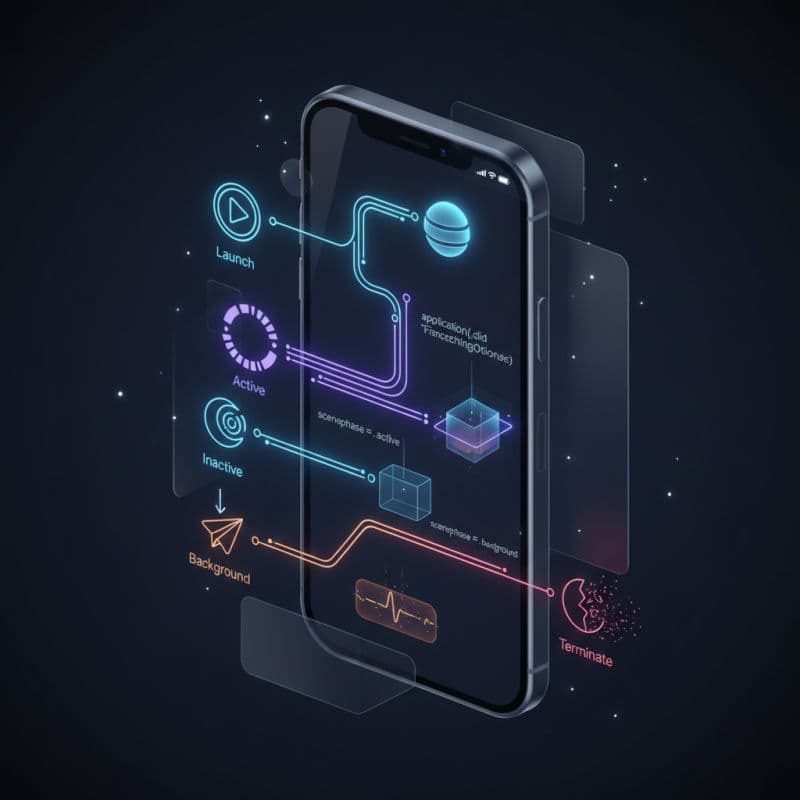
Introduction to the SwiftUI App Lifecycle
Before iOS 14, UIKit applications typically used AppDelegate.swift and SceneDelegate.swift to manage the application's lifecycle. While these files still exist for interoperability and specific use cases, SwiftUI applications, especially those targeting iOS 14 and later, introduced a new, declarative way to define your app's structure and manage its lifecycle: the App protocol.
The App protocol provides the entry point for your SwiftUI application. Instead of inheriting from UIApplicationDelegate, your main application structure now conforms to App. This shift significantly streamlines app setup and makes it more Swift-native. At its core, the SwiftUI App Lifecycle defines how your application launches, how its scenes (windows or tabs) behave, and how it responds to system events like backgrounding or termination.
Understanding this lifecycle is fundamental. Without it, you might struggle with data persistence, background task execution, or correctly reacting to user interactions when your app is brought to the foreground or sent to the background. This article will guide you through the modern SwiftUI App Lifecycle, focusing on the key components and how to leverage them for robust application development, specifically for iOS 14 and later.
The App Protocol: Your Application's Entry Point
The App protocol is the heart of your SwiftUI application. Every SwiftUI application must have one type that conforms to App. This type declares the content of your app, which is composed of one or more Scene instances. Think of the App protocol as replacing the role of UIApplicationMain and the AppDelegate's initial setup in older UIKit applications.
When you create a new SwiftUI project, Xcode automatically generates a file that looks something like this:
The @main attribute indicates that this struct is the entry point for your application. The body property returns one or more Scene instances that define the windows or UI that your app displays. It's crucial to understand that the App instance itself is quite lightweight; its primary role is to declare your app's scene graph.
For example, a typical app might use a WindowGroup as its main scene. WindowGroup is a flexible scene type that can display one or more instances of the same content, especially useful for multi-window iPad or macOS apps, but also the standard for single-window iPhone apps. Other scene types include Settings for macOS, DocumentGroup for document-based apps, and MenuBarExtra for macOS menu bar apps.
You typically won't manage state directly within the App struct for most application logic. Instead, you'll pass environment objects, state objects, or observed objects down to your scenes and views, allowing for a clean separation of concerns.
Compatibility: iOS 14.0+, macOS 11.0+, tvOS 14.0+, watchOS 7.0+
Scenes and ScenePhase: Managing UI State
Within the App protocol's body, you declare Scenes. A Scene manages a distinct piece of UI that SwiftUI can present to the user. For most iPhone apps, you'll primarily use WindowGroup to define your main UI. However, on iPad and Mac, WindowGroup allows for multiple windows of the same content to be opened, significantly enhancing multi-tasking capabilities.
An essential concept for managing scene-level state is ScenePhase. The ScenePhase environment value provides information about the current state of a scene. You can read this value using the @Environment property wrapper. Its possible values are:
.active: The scene is front-most and interactive..inactive: The scene is visible but not interactive, such as when a system alert is presented over your app, or the app is transitioning to the background..background: The scene is not visible, and its process might be suspended or terminated soon.
By monitoring ScenePhase, you can perform actions when your app comes to the foreground, goes to the background, or becomes inactive. This is critical for tasks like saving user data, releasing resources, or refreshing UI elements.
Let's look at an example where you might save data when the app enters the background and refresh data when it becomes active. You'll typically use the onChange(of:perform:) view modifier to observe changes to scenePhase.
Compatibility: iOS 14.0+, macOS 11.0+, tvOS 14.0+, watchOS 7.0+
View Lifecycle Considerations in SwiftUI
While App and Scene protocols define the overarching application and window lifecycle, individual Views also have their own conceptual lifecycle. It's important to differentiate this from UIKit's viewDidLoad, viewWillAppear, etc., as SwiftUI operates differently. Swift UI views are structs and are lightweight; they are created and destroyed frequently as state changes. Instead of specific lifecycle methods, you react to changes in state or environment.
Key mechanisms for reacting to a view's state changes include:
onAppear(): Executed when a view appears on screen. This is a common place to fetch data or perform initial setup specific to that view.onDisappear(): Executed when a view is removed from the screen (e.g., navigated away from, or condition making it visible becomes false). Use this for cleanup, stopping timers, or canceling network requests.onChange(of:perform:): Reacts to changes in a specific value within your view or its environment. This is the most versatile way to observe and react to state changes.
It's crucial to remember that onAppear and onDisappear can be called multiple times during a view's existence, especially with complex navigation or conditional views. Avoid placing logic that should only run once the very first time the app launches within these modifiers. For app-launch specific logic, use the App struct's onChange(of: scenePhase:) modifier as discussed earlier.
Let's illustrate how onAppear and onDisappear work within a NavigationView stack.
Compatibility: iOS 13.0+, macOS 10.15+, tvOS 13.0+, watchOS 6.0+
(onChange(of:) requires iOS 14.0+)
Handling App-level Background Tasks and Events
While ScenePhase helps manage scene-level backgrounding, sometimes your app needs to execute code even when all its scenes are in the background or when the app is launched in the background (e.g., for a silent push notification). SwiftUI's App Lifecycle integrates with UIKit's capabilities for these advanced background tasks.
For persistent background operations like fetching new data periodically, you might still need to register background tasks. SwiftUI doesn't introduce its own API for this, but rather relies on UIKit's mechanisms. You can use UIBackgroundTasksScheduler (introduced in iOS 13) or the older setMinimumBackgroundFetchInterval for UIApplication.
To integrate these with the SwiftUI App Lifecycle, you'd typically perform the registration within your App struct, perhaps in an init() or an onAppear of your main WindowGroup.
For example, to register a background refresh task, you would import BackgroundTasks and use its API. It's common to have a dedicated manager object that handles these background operations.
Another important aspect is handling URL schemes or Universal Links when your app is launched. While onOpenURL(perform:) is the primary way to handle URLs within a SwiftUI View, if you need to process a URL upon app launch before any view is fully presented, you might still use the AppDelegate or inject a handler into your SwiftUI App structure.
Here's an example of registering a basic background task identifier. You also need to enable the "Background Fetch" and "Background Processing" capabilities in your project settings Signing & Capabilities tab for this to work correctly.
Compatibility: iOS 13.0+ (for BackgroundTasks), iOS 14.0+ (for App protocol usage).
Environment Values and State Management in the Lifecycle
SwiftUI's declarative nature relies heavily on its robust state management system, which integrates closely with the app lifecycle. EnvironmentValues play a crucial role, providing access to system-wide or inherited values, such as scenePhase, colorScheme, locale, and custom environment keys you define.
When your app transitions through different lifecycle phases (active, inactive, background), SwiftUI automatically updates relevant EnvironmentValues. Views observing these values with @Environment will automatically re-render or execute their onChange modifiers.
Beyond EnvironmentValues, several property wrappers manage different types of state, each with its implications for the lifecycle:
@State: Simple, local mutable state for a single view and its subviews. Views with@Stateare recreated frequently.@Binding: A two-way connection to a mutable state owned by another view.@ObservedObject: For reference types conforming toObservableObjectthat contain observable state. When changes occur, the view is invalidated. You create these objects within the view that owns them, often using@StateObject.@StateObject: Similar to@ObservedObjectbut designed for creating and owning anObservableObjectinstance within a view's lifecycle. The object persists across view updates, making it ideal for persistent data managers or view models that need to survive view recreation. This is essential for preventing unnecessary re-initialization of complex objects.@EnvironmentObject: Allows you to inject anObservableObjectdeep into the view hierarchy without passing it through every initializer. It's suitable for app-wide shared data.
Understanding which property wrapper to use is key to efficient and correct state management that respects the SwiftUI App Lifecycle. For instance, if you have a data store that needs to persist throughout the app's lifetime and be accessible from multiple scenes, you might create it in your App struct and pass it down as an EnvironmentObject.
Compatibility: @State (iOS 13.0+), @ObservedObject (iOS 13.0+), @EnvironmentObject (iOS 13.0+), @StateObject (iOS 14.0+). EnvironmentValues for scenePhase (iOS 14.0+).
Here's an example demonstrating @StateObject and @EnvironmentObject in the context of the app lifecycle. Notice how AppWideSettings is created once in the App struct and then injected, ensuring it persists and can be accessed anywhere.
Compatibility: iOS 14.0+, macOS 11.0+
Advanced Lifecycle Customization: AppDelegate and UISceneDelegate Bridging
While SwiftUI's App protocol handles most modern lifecycle events, there are still scenarios where you might need to drop down to UIKit's AppDelegate or UISceneDelegate methods. This is particularly true for:
- Integrating third-party SDKs that require
application:didFinishLaunchingWithOptions:orscene:willConnectToSession:options:. - Handling specific push notification payloads (
application:didReceiveRemoteNotification:withcontent-available: 1). - Customizing initializers that are not directly exposed in the
Appprotocol, like early app setup tasks. - Deep linking or universal links if
onOpenURLisn't sufficient for complex routing logic that needs to occur very early.
To bridge the gap, you can use the @UIApplicationDelegateAdaptor property wrapper. This allows you to designate a traditional AppDelegate subclass to handle specific events that the SwiftUI App lifecycle doesn't natively expose.
When using @UIApplicationDelegateAdaptor, your AppDelegate instance will receive the traditional UIApplicationDelegate messages, allowing you to execute UIKit-specific setup or respond to events that fire before the SwiftUI App structure is fully initialized. Note that UISceneDelegate methods within AppDelegate are typically for multi-scene UIKit apps, but some legacy SDKs might still refer to them.
It's a good practice to minimize the logic within AppDelegate and SceneDelegate and push as much as possible into your SwiftUI App and Scene hierarchy for a more consistent and declarative approach. However, @UIApplicationDelegateAdaptor provides a powerful escape hatch when necessary.
Compatibility: iOS 14.0+, macOS 11.0+, tvOS 14.0+, watchOS 7.0+
Common Interview Questions
What is the primary entry point for a SwiftUI application?
The primary entry point for a SwiftUI application, especially those targeting iOS 14.0 and later, is a type that conforms to the `App` protocol, declared with the `@main` attribute. Its `body` property returns one or more `Scene`s that define the app's UI.
How do I detect when my SwiftUI app goes to the background or comes to the foreground?
You can detect these lifecycle events by observing the `scenePhase` environment value. Use `@Environment("scenePhase") var scenePhase` in your `App` or `Scene` body, and then attach an `onChange(of: scenePhase)` modifier to perform actions when the phase changes to `.active`, `.inactive`, or `.background`.
When should I use `@StateObject` versus `@ObservedObject`?
`@StateObject` should be used when a view *owns* the `ObservableObject` instance and needs it to persist throughout the view's lifetime, even if the view itself is recreated. `@ObservedObject` should be used when a view *observes* an `ObservableObject` that is owned by another source (e.g., passed down from a parent view or created elsewhere). Using `@ObservedObject` for ownership can lead to unexpected re-initialization.
Can I still use `AppDelegate` or `SceneDelegate` in a SwiftUI app?
Yes, you can. For scenarios that aren't natively covered by SwiftUI's `App` lifecycle (e.g., integrating certain third-party SDKs, custom deep link handling, or specific push notification events), you can use the `@UIApplicationDelegateAdaptor` property wrapper within your SwiftUI `App` struct to bridge to a traditional `AppDelegate` subclass.
How do I perform background tasks in a SwiftUI application?
SwiftUI applications use the same `BackgroundTasks` framework (or older `UIApplication` background fetch APIs) as UIKit apps. You'll typically register your background task identifiers within your `App` struct's `init()` or when your `WindowGroup` appears, and then schedule tasks when the app enters the background (e.g., using `onChange(of: scenePhase)`).