Mastering Polymorphism in Swift: Flexible & Reusable Code
Polymorphism, a cornerstone of object-oriented programming, allows objects of different classes to be treated as objects of a common type. In Swift, this powerful concept is primarily achieved through inheritance and protocols, enabling you to write highly flexible and reusable code. Understanding polymorphism is essential for building robust and scalable applications.
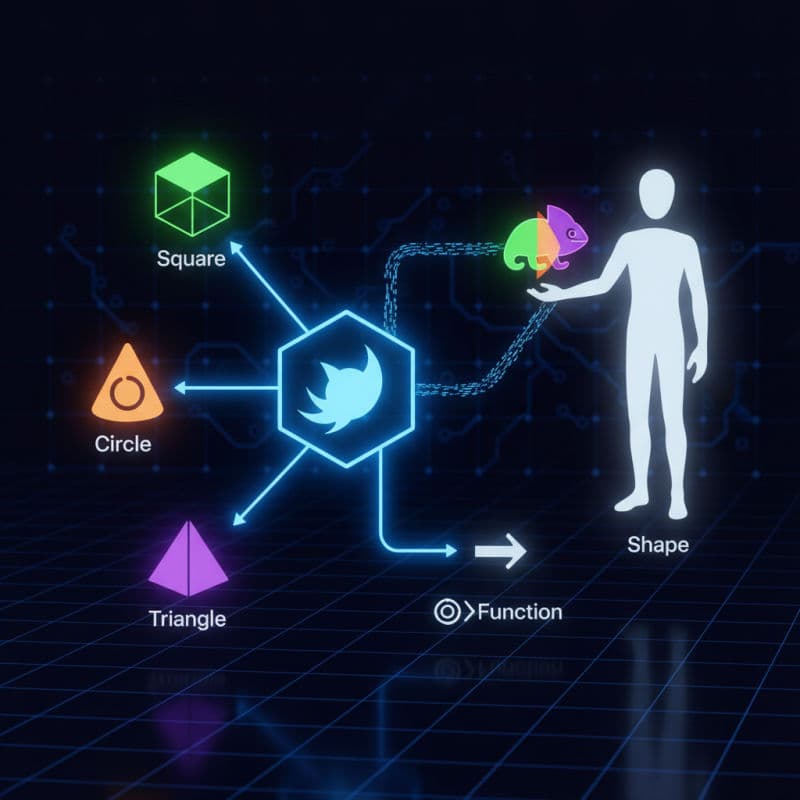
What is Polymorphism?
Polymorphism, derived from Greek meaning 'many forms,' is a fundamental concept in computer science that allows you to interact with objects of different types through a common interface. Imagine a remote control that can operate various brands of TVs; the remote (common interface) performs the powerOn() action, but each TV brand implements that action slightly differently. In Swift, polymorphism lets you write code that can work with objects of various sub-types without needing to know their exact type at compile time. This leads to more flexible, extensible, and maintainable software architectures.
At its core, polymorphism enables a single interface to represent different underlying forms. This capability is crucial for designing systems where components can be easily swapped or extended without altering the existing codebase that interacts with them. Swift achieves polymorphism primarily through two mechanisms: subclassing (inheritance) and protocols. Each has its strengths and use cases, and understanding both is key to leveraging polymorphism effectively in your applications.
This behavior is especially useful when you're dealing with collections of objects that share a common behavior but are otherwise distinct. For instance, you might have an array of Shape objects, but some are Circles and others are Squares. Polymorphism allows you to iterate through the array and call a draw() method on each, without needing to know if it's a circle or a square at the moment of the call.
Polymorphism with Inheritance in Swift
Inheritance is one of the primary ways to achieve polymorphism in object-oriented languages like Swift. When you define a base class, and then create subclasses that inherit from it, instances of these subclasses can be treated as instances of the base class. This is often referred to as 'subtype polymorphism.'
Consider a scenario where you have a base class Animal and several subclasses like Dog and Cat. Both Dog and Cat are Animals, so you can interact with them through an Animal reference. This means you can create an array of Animals that contains both Dog and Cat instances, and then call methods defined in the Animal class on each element, even if the subclasses override those methods.
Let's look at an example. We'll define a base Animal class with a makeSound() method, and then Dog and Cat subclasses that override this method.
Polymorphism with Protocols in Swift
Swift's protocols are a powerful means of achieving polymorphism, often preferred over class inheritance, especially for disparate types that share common behavior but not a common parent class. Protocols define a blueprint of methods, properties, and other requirements that a class, struct, or enum can adopt. When a type conforms to a protocol, it guarantees that it implements those requirements.
This approach, often called 'ad-hoc polymorphism' or 'protocol-oriented programming,' allows you to define a set of behaviors and then work with any type that conforms to that behavior, regardless of its inheritance hierarchy. This is incredibly flexible and aligns well with Swift's value type semantics.
Consider an example where you want to allow various types of objects to be able to 'greet.' It doesn't matter if it's a person, a robot, or even a virtual assistant; as long as it can greet, you can treat it polymorphically through a Greetable protocol.
Dynamic Dispatch and Type Casting
When you work with polymorphic types, particularly with inheritance, Swift uses a mechanism called dynamic dispatch (or late binding) to determine which specific implementation of a method to call at runtime. This means that even if you're holding an Animal reference, if the underlying object is a Dog, Swift will correctly call the Dog's overridden makeSound() method. This is the magic behind polymorphic behavior.
While dynamic dispatch is great for common interfaces, sometimes you might need to access methods or properties that are specific to a subclass or a different protocol a type conforms to. In these cases, you'll use type casting with the as? or as! operators.
as?: Attempt to downcast to a more specific type. Returns an optional, allowing you to gracefully handle cases where the cast fails.as!: Force downcast to a more specific type. Use with caution, as it will crash your app if the cast fails.
Let's extend our Animal example to demonstrate type casting. This is compatible with iOS 7.0+, macOS 10.9+, watchOS 2.0+, tvOS 9.0+.
Benefits of Polymorphism in Swift Development
Leveraging polymorphism in your Swift applications offers significant advantages, leading to more robust, adaptable, and maintainable software.
- Code Reusability: You can write generic functions or classes that operate on a common base type or protocol. This minimizes code duplication, as the same logic can handle different specific types. For example, a function that takes an array of
Greetableobjects doesn't need to know or care if they arePerson,Robot, orVirtualAssistantinstances. - Flexibility and Extensibility: New types can be introduced into your system without having to modify existing code. As long as these new types conform to the expected protocol or inherit from the base class, they will seamlessly integrate. If you add a
Parrotclass that inherits fromAnimaland overridesmakeSound(), yourzooarray from the example will still work perfectly. - Encapsulation and Abstraction: Polymorphism allows you to abstract away implementation details. You interact with objects based on their behavior (what they can do) rather than their exact type (how they do it). This reduces coupling between components and makes your system easier to understand and debug.
- Maintainability: Changes to the internal implementation of a specific type (e.g., how a
Dogbarks) don't require changes to the code that interacts with it polymorphically (e.g., thefor animal in zooloop). This isolation of concerns simplifies maintenance and reduces the risk of introducing bugs.
In essence, polymorphism helps you build systems that are 'open for extension, but closed for modification,' a cornerstone principle of good software design.
Common Interview Questions
What's the difference between inheritance-based and protocol-based polymorphism in Swift?
Inheritance-based polymorphism relies on class hierarchies, where subclasses can be treated as instances of their base class. It implies an "is-a" relationship (e.g., a `Dog` *is an* `Animal`). Protocol-based polymorphism, often favored in Swift, focuses on defining behaviors. Any type (class, struct, enum) can conform to a protocol, implying a "can-do" relationship (e.g., a `Person` *can greet*). Protocols offer greater flexibility as a type can conform to multiple protocols and work with value types, unlike inheritance which is restricted to classes and single inheritance.
When should I use `as?` versus `as!` for type casting with polymorphism?
You should almost always prefer `as?` for optional chaining (`if let` or `guard let`). It safely attempts to cast an object to a more specific type and returns `nil` if the cast fails, allowing your program to handle the failure gracefully. Use `as!` (forced downcast) only when you are absolutely certain that the cast will succeed at runtime. If the `as!` cast fails, your application will crash, making it suitable for situations where a failure indicates a critical programming error or an unrecoverable state.
Does polymorphism impact performance in Swift?
Yes, to some extent. Polymorphism, especially through class inheritance, often relies on dynamic dispatch, which means the specific method implementation to call is resolved at runtime. This typically involves a v-table lookup and is slightly slower than static dispatch (where the method call is resolved at compile time). However, in modern Swift applications, the performance overhead is usually negligible for most use cases and is far outweighed by the benefits of flexibility and maintainability. For performance-critical code, especially with value types, Swift's protocol-oriented programming sometimes allows for more static dispatch optimizations with generics, which can lead to faster execution than class-based dynamic dispatch.